

Reflections on CRLC's 20 Years
Founding Of CRLC
1999 saw the establishment of the Virginia Land Preservation Tax Credit program, which fueled great interest in land conservation. Around the same time, Richmond City Council, under the direction of then Mayor Tim Kaine, adopted Resolution No. 2000-R77-83 on May 22, 2000 to prepare conservation easements to protect four sites in the city creating increased awareness of urban land conservation. By 2005, Richmond City Council included the James River Park System, marking a pivotal year for the Richmond region. While established land trusts were prioritizing land conservation in regions across the Commonwealth, the Richmond region had little representation. Stepping in to fill the void was Bill Greenleaf who founded Capital Region Land Conservancy that year. Speaking to the Richmond Times-Dispatch in 2007, Bill noted, “We plan for growth, so we need to plan for what natural areas we should focus on protecting.”
What is a Conservation Easement?
Under federal law, IRS section 170(h) notes a deductible conservation easement is an easement granted for preservation of land areas for outdoor recreation, protection of habitat, preservation of open space, or preservation of historically important land area or buildings. It also notes that the conservation easement must have permanent and specific restrictions to protect the conservation purposes and must be granted to a “qualified organization” that has the resources to enforce such restrictions. Notably for Virginia, Virginia Conservation Easement Act requires the “holder” of the conservation easement to be an organization in existence for at least five years, with an exception for co-holding with another qualified organization that meets the requirement.
While Virginia’s law required Capital Region Land Conservancy to be collaborative at its founding, partnerships have been at the heart of our work from the start.
The First 10 Years
On December 20, 2006, CRLC co-held its first conservation easement with the Virginia Outdoors Foundation (VOF) on 337 acres in Powhatan County. But the historic move on June 9, 2009 to permanently protect the James River Park System was a turning point for CRLC in partnering with the City of Richmond to become the first city to place an urban park system under conservation easement Over 400 acres across the city are today permanently protected under a co-held easement with the Virginia Department of Conservation and Recreation (DCR).
CRLC continued to make a name for itself by merging with the Goochland Land Alliance in 2012 and the Friends of Chesterfield Riverfront in 2014. These collaborations added 289 acres plus three co-held easements protecting 278 acres with the James River Association to CRLC’s roster. We additionally record a total of four co-held easements protecting 827 acres with DCR, VOF, Henricopolis Soil & Water Conservation District, and Land Trust of Virginia. CRLC facilitated a gift of 109 acres to Chesterfield County for a future park with a third-party right of enforcement to CRLC that operates similarly to a conservation easement. By 2015, CRLC was stewarding more than 1,500 acres.
2016 to Today
In 2016, CRLC recorded its first independent conservation easements. Today, CRLC stewards over 5,000 acres under 46 separate conservation easements that span all the localities that make up the Richmond region. Half of these easements are co-held with eight partnering organizations, whom CRLC greatly values for their own expertise.
There are many people that preceded the current CRLC staff though it has been the joint tenure of Jane T. Myers, Director of Land Conservation (16 years), and Parker C. Agelasto, Executive Director (10 years), that propelled CRLC into its second decade and established the organization as a preeminent land trust. Myers and Agelasto worked diligently to increase public awareness of the importance of permanent and enforceable land conservation. This renewed vigor resulted in recording six conservation easements protecting a total of 682 acres in 2017.
CRLC also began accelerating the pace at which it could conserve land by actively acquiring land on the open market. The first contract was to purchase 871 acres at Malvern Hill Farm signed in 2016 for $6.6 million. While CRLC drew the “short straw” at a meeting with other conservation organizations, it was the assurance of these partners, in particular The Conservation Fund, that agreed to lend the funds that enabled CRLC to enter into such a significant transaction. When CRLC successfully completed the acquisition and protection of Malvern Hill Farm, it proved it was, “the little engine that could.”
The partnerships that made the protection of historic Malvern Hill possible demonstrated once again the power of collaboration to pull off a bold vision. In looking back, a huge heartfelt thanks is offered to The Conservation Fund, Henrico County, National Park Service, American Battlefield Trust, James River Association, Virginia Outdoors Foundation, and the many donors who believed in us. This project was the keystone to building a more robust land trust in the Richmond region.
Not too weary from its success at Malvern Hill Farm, CRLC’s staff and Board set out to tackle the monumental effort to acquire 5.1 acres at Dock Street along the James River in downtown Richmond. CRLC again brought partners to the table to complete this $5 million acquisition that today is open as a public park and hosts the James River Association’s James A. Buzzard River Education Center, and forever protects “The View That Named Richmond.” CRLC continued to implement the Richmond Riverfront Plan as it acquired the property along Brander Street for the Richmond Slave Trail as well as Mayo’s Island Over the past five years, CRLC worked to raise $25 million to acquire and protect over 25 acres along the river to bolster the award-winning outdoor destination for residents and visitors alike.
At the same time, CRLC acquired additional lands for public access and future parks including the Campbell’s Bridge Mills site in Chesterfield County along the Appomattox River and the Varina LandLab Conservation Area and nearby properties within the New Market Heights Battlefield. Through a process in the land trust profession known as “buy, protect, sell,” CRLC has effectively conserved 956 acres where the land was purchased at fair market value, protected through a conservation easement and transferred to its ultimate owner, such as the National Park Service, City of Richmond, Chesterfield County, and Henrico County. Today, CRLC owns approximately 696 additional acres that it is managing for the public’s benefit, including an additional 30 acres in the City of Richmond for future parks in communities that currently do not have access to a public green space within a 10-minute walk.
Ten years ago, CRLC was managed by two part-time with an operating budget under $100,000. There is still a direct correlation to fundraising and capacity but thanks to an annual budget over $1 million and three full-time and three part-time staff, CRLC is better positioned to tackle the needs of the fastest growing region in the state.
Partnerships at the Heart of Our Practice
Many of the largest projects that CRLC has accomplished have been in part due to federal and state grants that were awarded to projects through very competitive grant applications. CRLC was introduced to these grant processes when it acquired Malvern Hill Farm. A quick glimpse at these cumulative amounts and sources reveals how CRLC has learned and evolved to meet the demand to conserve land in the Richmond region – most notably $4.5 million from National Park Service’s American Battlefield Protection Program; $3.3 million from Virginia Land Conservation Foundation with another $1.75 million committed to ongoing projects including Mayo’s Island; $2.1 million from Land and Water Conservation Fund; $1.75 million from Virginia Battlefield Preservation Fund, $7.5 million from the Virginia Community Flood Preparedness Fund for Mayo’s Island; and $400,000 from the Virginia Outdoors Foundation with another $1 million committed to multiple ongoing projects. That’s over $22 million in grant funding that CRLC has invested into the local economy that would otherwise go to different communities.
CRLC is honored to have also received many grants from private foundations to use as match for these grants. These include the Cabell Foundation, Mary Morton Parsons Foundation, and Robins Foundation among others. Notably our ability to learn and raise the significant funding noted above is a result of the investment that many private donors have contributed as well as grants that supported CRLC’s capacity building. A special thanks to the Chesapeake Bay Trust, Community Foundation for a greater Richmond, and Virginia Environmental Endowment as well as grants over the years from Altria, Dominion Energy, Luck Stone, Universal Leaf, and Vulcan Materials as well as our current corporate partners – Davey Mitigation, Engel Family Farm, Evergreen, Haley Auto, and RES.
With regard to the customary practice of recording a conservation easement on private land that continues to be owned and operated by the landowner but subject to the terms of the restrictions in the easement, CRLC conserved an additional 2,738 between 2017 and 2024, with last year being the most successful. In the past 20 years, CRLC has facilitated the permanent protection of more than 15,000 acres. Approximately 6% of the land in the Richmond region is classified as conserved lands.
Looking Ahead
CRLC’s current strategic plan is ambitious and sets a goal to conserve 10% of the land in the Richmond region by 2030. That means another 65,000 acres!
Can we do it?! Yes, we can!
But we can’t do it without dedicated staff, partners, and donors. With Myers and Agelasto, CRLC has a great staff to include Gray Montrose, Deputy Director of Land Conservation; Ashley Moulton, Land Conservation Manager; Christina Newton, Community Engagement Manager; and Matt Szucs, Donor Relations Manager. Looking ahead to the 25 anniversary, CRLC is seeking to grow to 8 – 10 staff to continue accelerating the pace at which land is conserved in the Richmond region and meet our goals.
THANK YOU! Thank you to all that have contributed great or small, and in your own way, during the first 20 years in building Capital Region Land Conservancy. We hope to see you on the trail as we journey into a future that we hope CRLC’s contributions will only make better.
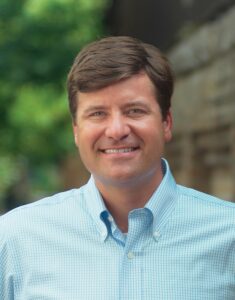
Parker C. Agelasto
Executive Director


