
This article was originally published in the Richmond Times-Dispatch by author Michael Paul Williams; May 14, 2026.
“A site in Varina that served as an encampment for U.S. Colored Troops during the Civil War has been gifted to an area nonprofit to provide fledgling farmers of color with a place to live and provide much-needed fresh food to the underserved community.
Capital Region Land Conservancy (CRLC) has transferred 61 acres of land — including 54 acres of prime farmland — to the Central Virginia Agrarian Community Land Trust (CVACLT), a nonprofit that supports Black, Indigenous and People of Color efforts to gain land for building resilient regional food systems.
The donated acreage is split by the Virginia Capital Trail in eastern Henrico County, at a site along the trail that feeds into Dorey Park, home to a popular weekend Farmer’s Market from June through October.
“I feel like the proximity is super exciting, right?” said Duron Chavis, an urban farming leader and board member for the Central Virginia Agrarian Community Land Trust. “The fact that it’s literally a stone’s throw away is gonna give opportunities for folks to be able to do less work in terms of traffic and moving the produce from here to there.”
He’s also thrilled by the historical connections at the site. Whereas Black troops fought to free the enslaved and preserve the Union, this land transfer seeks to preserve dwindling farmland and act as a form of restorative justice for Black farms lost to lender discrimination, heirs’ property or racial terror.
“The most exciting part about it is the history of it for us, being a former encampment for the United States Colored Troops,” Chavis said. “In our work explicitly around creating equitable solutions and strategies for community power around Black and brown communities, it’s like the alignment is perfect.”
This land transfer aligns with efforts nationally and in Henrico to preserve farmland from development through conservation easements. Between 1982 and 2022, Henrico County lost more than 25,000 acres of farmland, according to federal data cited by CRLC. That leaves fewer than 8,000 acres of active farmland on 84 registered farms.
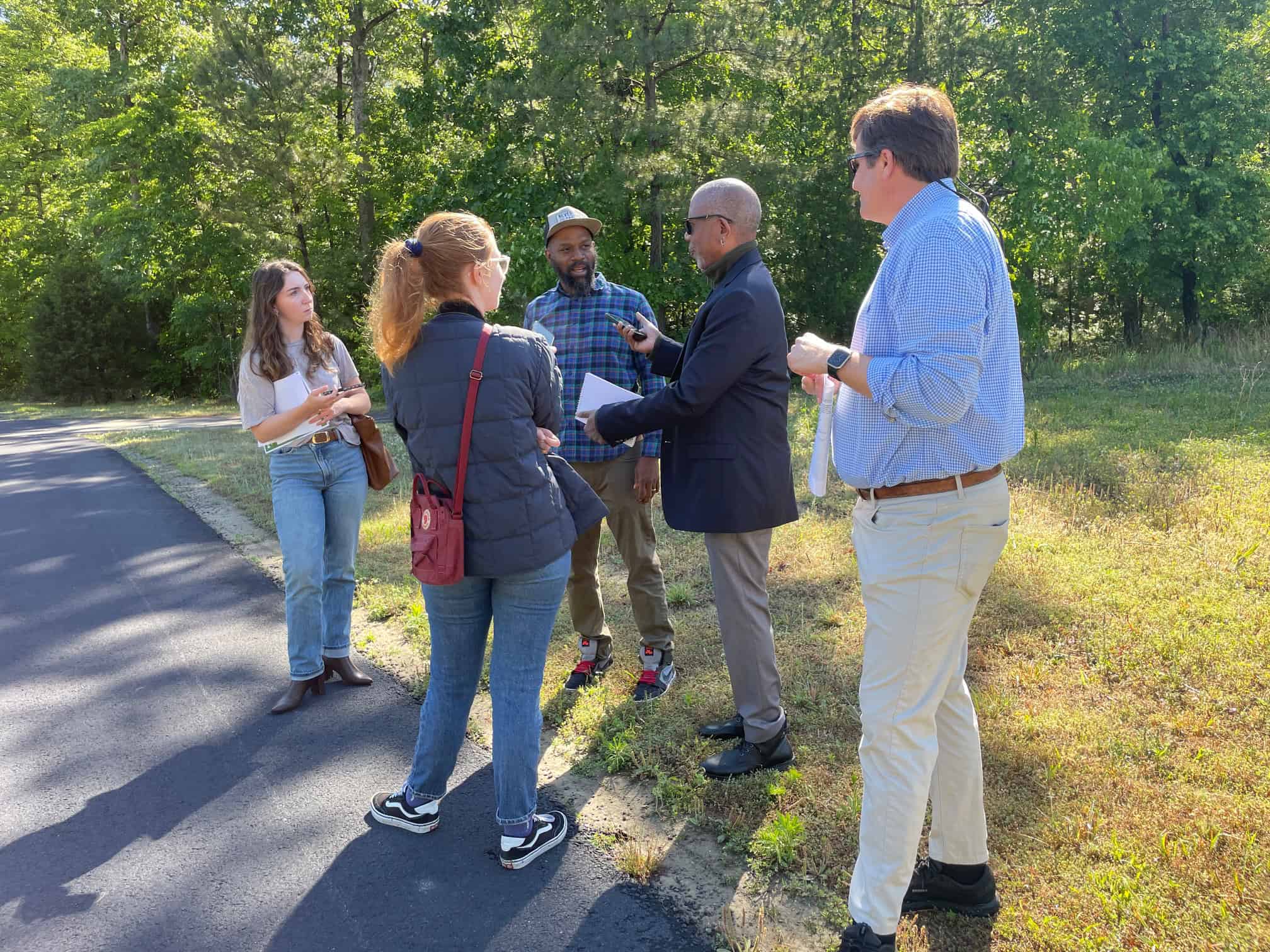
As cyclists occasionally whizzed by on a gorgeous Tuesday morning, Parker Agelasto, executive director of CRLC, and Chavis conducted a walking tour of the site, which is bisected by an area of the Capital Trail that veers off Route 5 and rolls through agricultural land. One part of the gifted land is zoned residential; the other, agricultural. The residential area will have to be rezoned to allow for commercial agriculture.
The land transfer was possible through a gift by Randy Welch, who donated 61 acres to CRLC at New Market and Doran roads. CRLC received $400,000 from the Virginia Outdoors Foundation’s Preservation Trust Fund to put a conservation easement on the property.
The relationship between Agelasto and Chavis dates to the former’s time on Richmond City Council, when Chavis was honing his initial urban farming chops at the McDonough Community Garden on Richmond’s Southside.
Since then, Chavis has founded the 5-acre Sankofa Community Orchard in South Richmond and the Petersburg Oasis Community Farm, among other efforts. And several years ago, CVACLT was the recipient of 80 acres in Amelia County — land donated by Callie Walker, the daughter of an Amelia cattle farmer, as a form of reparations for the descendants of the enslaved.
Efforts to fashion a residential community on that farmland — as well as affordable housing at the Bensley Agrihood in Chesterfield County, in partnership with Girls for A Change and the Maggie Walker Community Land Trust — hit roadblocks with local government. But Chavis and Agelasto see more hospitable soil in Henrico, where Chavis is already partnering with the county at the 20-acre Runnymeade Community Farm.
Indeed, Varina Supervisor Tyrone Nelson, in a Capital Region Land Conservancy news release, applauded the land transfer, noting that in his 14 years as supervisor, “I have also heard from many constituents about the importance of preserving farmland here.”
“The biggest challenge to farm operations is that they are tenants on the land,” Agelasto said. “More than 60% of farmland in the country is rented. Now, we talk about renters in housing situations, where the city of Richmond has more than 60% of its population as renters, and what do we talk about: We talk about evictions, we talk about affordability, we talk about all these issues.
“Well, the same problems that affect renters in Richmond affect farmers everywhere else in the world. So, getting ownership, having equity for farmers, is critically important,” he said.
Chavis envisions at least four tiny homes on the property, and eventually, a visitor’s center for historical interpretation of the U.S. Colored Troops and the agricultural work. “The real aspiration is that this space will be for farmers — folks that want to learn how to farm or want to have access to land. They’ll be able to stay and have an affordable place to live in.”
Almost 15 million acres have been lost by Black farmers since the 1910s, Chavis said. “What that means for an aspiring farmer that’s trying to get in the game is that they have very few options in terms of inheritance, and people that they can ask that look like them to participate inside of the work.”
He said the land trust will provide an alternative by retaining ownership of the land but providing no-cost or low-cost leases to aspiring farmers.
“Being a way to cultivate the next generation of farmers is of extreme importance, especially if we’re talking about issues like increasing access to healthy food, food deserts, food justice,” he said. Getting the communities most impacted by food access issues engaged in agriculture as a vocation “is the real solution we’re trying to drive toward.”
“In 2020, we had this whole racial reckoning, and the conversation was about racial equity. In this moment, we’re talking real equity, right? Land, ownership by community organizations of color.” He’s excited by what this might mean looking forward.